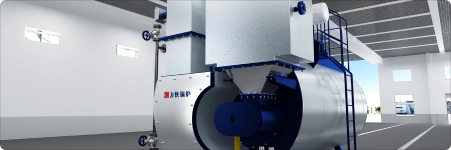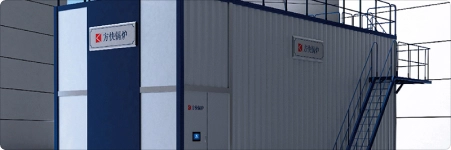



A boiler is a device that uses the thermal energy released from fuel combustion or other heat sources to heat water or other working fluids, in order to produce steam, hot water, or other working fluids with specific parameters. Boilers are commonly used in thermal power plants, other industries, and civilian production.
A boiler consists of two main parts: the "pot" and the "furnace." The "pot" is the container that holds the water, and it is made up of a drum and many steel tubes. The "furnace" is the place where the fuel is burned.
The basic working principle of a boiler is to convert the chemical energy released from fuel combustion into thermal energy, and then transfer this thermal energy to water or other working media through heat transfer, heating, vaporizing, or generating superheated steam. Specifically, the working principle of a boiler includes the following processes:
Combustion Process: Fuel burns in the furnace, generating high-temperature flue gas. This process is the starting point of boiler operation and the primary source of thermal energy.
Heat Transfer Process: The high-temperature flue gas transfers heat to water or other working media through heat exchangers (such as water tubes or smoke tubes). During this process, the high-temperature flue gas exchanges heat with water or working media, heating and converting them into steam or hot water.
Steam-Water Circulation Process (for steam boilers): The heated water generates steam within the boiler, which is then transported through pipelines to where it is needed for use. For hot water boilers, the heated water is circulated for heating purposes using a circulation pump.
Boilers can be classified based on various criteria, such as fuel type, structural form, and purpose. Here are some common classification methods:
Classification by Fuel Type: Coal-fired boilers, oil-fired boilers, gas-fired boilers, electric boilers, etc.
Classification by Structural Form: Vertical boilers, horizontal boilers, water-tube boilers, fire-tube boilers, etc.
Classification by Purpose: Power station boilers (used for electricity generation), industrial boilers (used in industrial production), domestic boilers (used for heating or hot water supply in civilian or commercial settings), etc.
Boilers have a wide range of applications in industrial production and people's daily lives. In industrial production, the steam or hot water generated by boilers can be used for heating, drying, distillation, power generation, and other processes. In civilian applications, boilers are mainly used for heating and hot water supply.
In summary, as an important energy conversion equipment, boilers play an irreplaceable role in industrial production and people's daily lives. Understanding their working principles and classifications is essential for better use and maintenance of boiler equipment.
This Christmas, industrial hot water boilers keep buildings warm and steam boilers keep processes running. With intelligent PLC control and remote monitoring, FangKuai Boiler solutions ensure stable, safe operation for commercial and industrial applications — even during the holidays.
Qingdao, China — Autumn 2025 — FangKuai Boiler Co., Ltd. made a striking appearance at the 67th National Pharmaceutical Machinery Expo & China International Pharmaceutical Machinery Expo held in Qingdao. As a leading name in industrial boiler technology, FangKuai’s booth at Hall CW-9 (West Entrance) drew steady crowds and emerged as one of the event’s standout attractions.
The efficiency of a gas-fired steam boiler depends on multiple factors, including technology type, design, fuel utilization, and operating conditions. Currently, the most efficient types on the market are: